Nazi Movement in the United States Diamond Review

A foundational text of modern antisemitism by Henry Ford.
Nazism in the Americas has existed since the 1930s and continues to be today. The membership of the primeval groups reflected the sympathies of some German-Americans and High german Latin-Americans toward Nazi Germany, embracing the spirit of Nazism in Europe and establishing it within the Americas. Throughout the inter-war period and the outbreak of Earth War Ii, American Nazi parties engaged in activities such every bit sporting Nazi propaganda, storming newspapers, spreading Nazi-sympathetic materials and infiltrating other non-political organizations.
The reaction to these parties varied, ranging from widespread support to outright resistance, including the germination of the first anti-Nazi Jewish resistance organizations in the U.s.a., such as the Not-Sectarian Anti-Nazi League to Champion Human Rights.[1]
United States [edit]

Inter-state of war menstruation [edit]
Adolf Hitler became chancellor of Frg on Jan 30, 1933.[2] German-Americans for years[ when? ] attempted to create pro-Nazi movements in the U.S., often bearing swastikas and wearing uniforms. These groups had petty to do with Nazi Deutschland and lacked support from the wider High german-American community.[3] In May 1933, Heinz Spanknöbel received authority from Rudolf Hess, the deputy führer of Federal republic of germany, to form an official American branch of the Nazi Party. The co-operative was known equally the Friends of New Germany in the U.S.[iii] The Nazi Political party referred to it as the National Socialist German Workers' Party of the UsaA.[2] Though the party had a potent presence in Chicago, it remained based in New York Metropolis, having received back up from the German delegate in the city. Spanknöbel's organisation was openly pro-Nazi. Members stormed the German-language newspaper New Yorker Staats-Zeitung and demanded that the newspaper publish articles sympathetic to Nazis. Spanknöbel's leadership was brusque-lived, as he was deported in Oct 1933 post-obit revelations that he had non registered every bit a foreign agent.[3] Some American corporations had trade relations that continued even after declarations of state of war.[4]
Globe War 2 [edit]

Kuhn speaking at a Bund rally
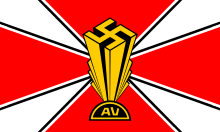
Flag of the German American Bund
The Friends of New Deutschland dissolved in the 1930s. The German American Bund, led by Fritz Kuhn, formed in 1935 and lasted until America formally entered Globe State of war II in 1941. The Bund existed with the goal of a united America under indigenous German language rule and following Nazi credo. It proclaimed communism as their primary enemy and expressed anti-Semitic attitudes.[three] Inspired by the Hitler Youth, the Bund created its own youth division, where members "took German lessons, received instructions on how to salute the swastika, and learned to sing the 'Horst Wessel Lied' and other Nazi songs."[five] The Bund continued to justify and glorify Hitler and his movements in Europe during the outbreak of World War II. After Germany invaded Poland in 1939, Bund leaders released a statement enervating that America stay neutral in the ensuing conflict, and expressed sympathy for Germany'southward state of war effort. The Bund reasoned that this back up for the German war endeavour was non disloyal to the U.s.a., equally German-Americans would "proceed to fight for a Gentile America free of all atheistic Jewish Marxist elements."[five]
After many internal and leadership disputes, the Bund's executive committee agreed to disband the party the day after the bombing of Pearl Harbor. On December 11, 1941, the United States formally declared war on the Axis powers, and Bund headquarters were raided by Treasury Department agents. The agents seized all records and arrested 76 Bund leaders.[5]
Later on Earth State of war II [edit]
The Office of Special Investigations estimated effectually ten m Nazi state of war criminals entered the United states of america from Eastern Europe after the conclusion of World State of war II.[six] Some were brought in Operation Paperclip, a project to bring German scientists and engineers to the U.South. Most Nazi collaborators entered the Us through the 1948 and 1950 Displaced Persons Acts and the Refugee Relief Act of 1953. Supporters of the acts showed only a slight awareness of the possibility of Nazi war criminals' entering the U.s. through them. Most of the supporters' business organisation was about disallowing known communists from entering. This shift of focus was probable due to the pressures of the Cold War in the years after World State of war 2, when the U.s.a. focused on countering Soviet communism more than Nazism.[6]

Eichmann photographed in or effectually 1942
During the 1950s, several investigations into suspected Nazi war criminals were conducted by the Clearing and Naturalization Service, merely no official trials came from these investigations. The Holocaust and the possibility of Nazi collaborators living in the country entered the national discussion in the 1960s with the trial of Adolf Eichmann, accusations of war criminals during Soviet state of war crimes trials, and a serial of manufactures published by Charles R. Allen detailing the presence of Nazi state of war criminals living in the U.S. The federal government began to focus on uncovering Nazi war criminals remaining in the country.[6] Public awareness of the Holocaust and remaining Nazi war criminals increased in the 1970s. Many cases made headline news. The case of Hermine Braunsteiner-Ryan, who was the first Nazi state of war criminal to be extradited from the U.s.a., received widespread media coverage. The instance triggered the Clearing and Naturalization Service to further locate Nazi collaborators. By the late 1970s, INS addressed thousands of cases, and the U.S. government formed the Part of Special Investigations, which was dedicated to locating Nazi state of war criminals in the U.s.a..[half dozen]
Neo-Nazism emerged every bit an ideology during this time,[vii] seeking to revive and implement Nazi ideology. Neo-Nazis seek to employ their ideology to promote hatred and white supremacy, attack racial and ethnic minorities, and create a fascist state.[8] [9] Neo-Nazism is a global phenomenon, with organized representation in many countries and international networks. Information technology borrows elements from Nazi doctrine, including ultranationalism, racism, xenophobia, ableism, homophobia, anti-Romanyism, antisemitism, anti-communism, and creating a Fourth Reich. Holocaust deprival is common in neo-Nazi circles.
In the United States, organizations such as the American Nazi Political party, the National Alliance and White Aryan Resistance were formed during the second one-half of the 20th century.[ten] The National Alliance founded in the 1970s by William Luther Pierce, author of The Turner Diaries, was the largest and nearly active neo-Nazi group in the The states in the 1990s.[11] [x]
21st century [edit]
![[icon]](https://upload.wikimedia.org/wikipedia/commons/thumb/1/1c/Wiki_letter_w_cropped.svg/20px-Wiki_letter_w_cropped.svg.png) | This section needs expansion. You lot tin help past adding to it. (February 2021) |

Affiche for the stage accommodation of It Can't Happen Here, Oct 27, 1936 at the Lafayette Theater equally part of the Detroit Federal Theatre
According to the Southern Poverty Police force Center, the National Alliance had lost near of its members by 2020 but is still visible in the U.Southward.[11] [12] Other groups, such as Atomwaffen Sectionalisation have taken its place.[13] American Neo-Nazi groups accept moved towards more decentralized arrangement and online social networks with a terroristic focus.[12]
South America [edit]
Inter-war period [edit]
The National Socialist Move of Chile (MNSCH), or el nacismo, formed in 1932. It was founded by Carlos Keller Rueff and Jorge Gonzalez von Marees, both of German language heritage, likewise every bit Juan de Dios Valenzuela and Gustavo Vargas Molinare(es). The members were referred to every bit Nacistas and the party had a pyramid-structured hierarchy led past a Jefe. It also included shock troops called the TNA.[ clarification needed ] The party lacked a militant stand on racial matters, unlike European Nazism, as the matter of racial purity was non important in Chile and was deemed[ by whom? ] counter to the national tradition. Yet, the MNSCH operated like many other fascist movements, with emphasis on totalitarianism, military machine values, elitism, hierarchy, discipline and the need for action. The MNSCH also held the view that the individual should serve the nation equally a part of a higher organism needed for self-preservation, and the political party advocated the demand for a totalitarian, unified society akin to European Nazism. They deplored elections and declared themselves anti-democratic, anti-liberal, anti-Marxist, anti-conservative, anti-oligarchist, and anti-imperialist.[14]
World War Two [edit]
Some South American countries were opposed to the Axis powers and Nazism in Europe, peculiarly after the bombing of Pearl Harbor in 1941. Others maintained that continuing economic relations with countries on both sides of the war would exist beneficial. German, Italian, and Spanish influences were strong in Argentina due to a high number of immigrants. Fascist sentiments permeated the political and military spheres, especially after the Revolution of '43, a trend that continued during Perón's populist assistants and eventually led to over 40 years of military dictatorship. [fifteen] There was opposition to the German customs in Republic of chile due to the 1938 Seguro Obrero massacre. The U.s.a. issued radio broadcasts and move pictures during the war in club to generate and spread anti-fascist propaganda beyond Latin America.[16]
Later on World War II [edit]
After World State of war II ended, many Nazis and other fascists fled to South America through the use of ratlines. Many of these ratlines were supported by the Catholic Church. The commencement movements to smuggle Nazis and fascists came in 1946 when two Argentinian bishops colluded with a French cardinal to bring French state of war criminals into Argentine republic. Nether Argentine president Juan Perón's instructions, many European war criminals were brought into the state and given citizenship and employment.[17]
See also [edit]
- KKK
- Nazism in Brazil
- Fascism in South America
- Nazism in Chile
- Fascism in Europe
- Nazi sympathizers in Guatemala
- Fascism in Canada
- Fascism in North America
Bibliography [edit]
- Blackness, Edwin (2001). IBM and the Holocaust: The Strategic Alliance betwixt Nazi Federal republic of germany and America's Most Powerful Corporation. [South.l.]: Crown Publishers. ISBN 9780914153276
- HITLER'S SHADOW Nazi State of war Criminals, U.Southward. Intelligence, and the Cold War
- From Germany to the United States: Universalizing the Quaternary Reich in the Turbulent 1960s. (2019). The Fourth Reich, 158–190. doi:10.1017/9781108628587.006
References [edit]
- ^ Hawkins, Richard A. (2013), "The internal politics of the Non-Sectarian Anti-Nazi League to Champion Homo Rights, 1933–1939", Direction & Organizational History, five (two): 251–78, doi:10.1177/1744935910361642, S2CID 145170586]
- ^ a b Diamond, Sander A. "The Years of Waiting: National Socialism in the United States, 1922–1933." American Jewish Historical Quarterly, vol. 59, no. 3, 1970, pp. 256–271. JSTOR, www.jstor.org/stable/23877858.
- ^ a b c d Jim Bredemus. "American Bund – The Failure of American Nazism: The German-American Bund's Effort to Create an American "Fifth Column"". TRACES.Retrieved May second 2019.
- ^ Kodak's Nazi Connections
- ^ a b c Bell, Leland Five. "The Failure of Nazism in America: The High german American Bund, 1936–1941." Political Scientific discipline Quarterly, vol. 85, no. 4, 1970, pp. 585–599. JSTOR, www.jstor.org/stable/2147597
- ^ a b c d Schiessl, Christoph. Declared Nazi Collaborators in the United states after World War II. Lanham: Lexington Books, 2016.
- ^ "The Danish Middle for Holocaust and Genocide Studies". 2007-11-09. Archived from the original on 2007-11-09. Retrieved 2021-02-27 .
- ^ Gay, Kathlyn (1997) Neo-Nazis: A Growing Threat. Enslow. p. 114. ISBN 978-0894909016. Quote: "Neo-Nazis ... employ fright and violence in their efforts to destroy minorities. Their goal is to plant a "superior" gild."
- ^ Staff (ndg) "Ideologies: Neo Nazi" Southern Poverty Law Centre. Quote: "While some neo-Nazi groups emphasize simple hatred, others are more focused on the revolutionary cosmos of a fascist political state." (emphasis added)
- ^ a b "Neo-Nazism". www.jewishvirtuallibrary.org . Retrieved 2021-02-27 .
- ^ a b "National Alliance". Southern Poverty Law Heart . Retrieved 2021-02-27 .
- ^ a b "Neo-Nazi". Southern Poverty Law Middle . Retrieved 2021-02-27 .
- ^ "Atomwaffen Division". Southern Poverty Law Center . Retrieved 2021-02-27 .
- ^ Etchepare, Jaime Antonio, and Hamish I. Stewart. "Nazism in Republic of chile: A Particular Type of Fascism in South America." Journal of Gimmicky History 30, no. iv (1995): 577–605
- ^ Leonard, Thomas One thousand; John F. Bratzel (2007). Latin America During World War II.Rowman & Littlefield. ISBN 0742537412.
- ^ Kornel Chang, "Muted reception: United states of america propaganda and the structure of Mexican popular opinion during the Second World War." Diplomatic History 38.3 (2013): 569–598.
- ^ Goñi, Uki (2003). The Real Odessa: Smuggling the Nazis to Perón's Argentina (revised ed.). London: Granta
Source: https://en.wikipedia.org/wiki/Nazism_in_the_Americas
0 Response to "Nazi Movement in the United States Diamond Review"
Post a Comment